In order to support surgeons in the daily management of hand and forefoot pathologies, Newclip Technics has developed a new generation of hexalobe cannulated screws available in various diameters and shapes. This offering has been designed to adapt to each indication, the patient’s anatomy, and the preferences of each surgeon.
To facilitate patient flow management and reduce surgical lead times, Newclip Technics has packaged this screw range in a sterile single-use format: INITIAL S EVO*.
Each kit includes the instrumentation required for screw insertion (and, when applicable, compression washers for headed screws), intended exclusively for use in orthopedic and trauma surgery with Newclip Technics implants.
The INITIAL S EVO range is available in two sub-ranges:
– INITIAL S EVO – Hand : Ø1.7 mm
– INITIAL S EVO – Foot : a selection of headless and headed screws, available in Ø2.25 mm, Ø2.6 mm, Ø3.0 mm, Ø3.5 mm and Ø4.0 mm.
*The screws are not included in the INITIAL S EVO kit; they are available separately in sterile single-unit packaging.
Our sterile solution : INITIAL S EVO – Hand.
The Initial S EVO – Hand range offers a sterile instrumentation kit dedicated to the insertion of Ø1.7 mm cannulated screws for the treatment of hand fractures.
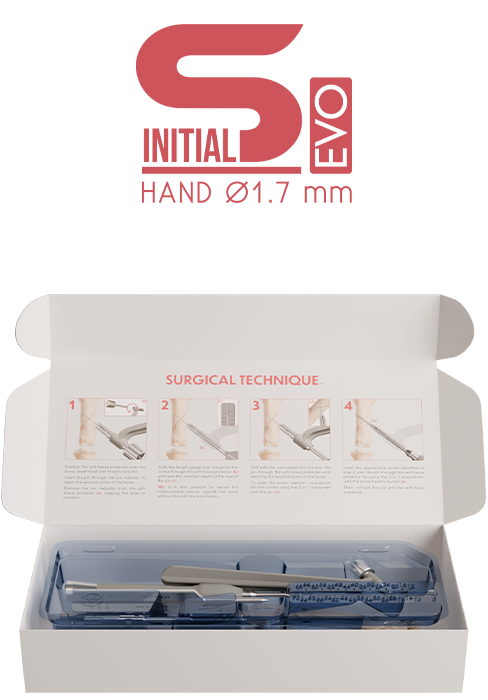
- Partially threaded self-compressive screws, L08 mm to L20 mm, 0.65 mm cannulation
- Fully threaded positioning screws, L12 mm to L20 mm, 0.65 mm cannulation
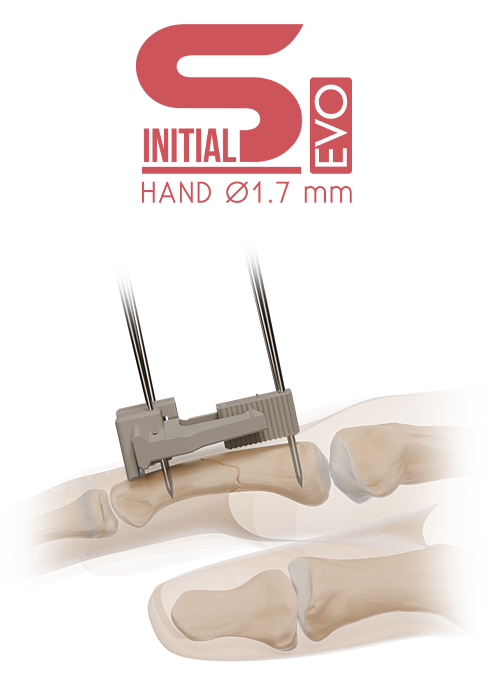
- Compact solution
- Minimally invasive technique (percutaneous / Ø1.2 mm pins)
- Radiolucent with 3 radiopaque markers for easy positioning under X-rays
- Reduction management in two planes: rotation and translation
- Available in a single-use version only (1 reduction tool + 4 Ø1.2 mm pins)
Key features of the INITIAL S EVO – Hand kit.
- Self-drilling and self-tapping cannulated screws with hexalobe recess
- 2 thread types: partially threaded and fully threaded
- Patented reduction instrument facilitating fracture reduction, compression, and stabilization
- 2-in-1 instrument enabling cortical preparation (countersink) and screw insertion (screwdriver)
- Sterile single-use format, ready to use and suitable for emergency situations:
- No hospital sterilization costs
- Reduced risk of contamination¹
- Immediate availability: no waiting time for restocking
- Reduced operative time and costs²–³
- Easier traceability thanks to detailed labeling
- Ergonomic format adapted to instrument sets³
Mont et al. Single-use instrumentation, cutting blocks, and trials decrease contamination during total knee arthroplasty: a prospective comparison of navigated and nonnavigated cases. J Knee Surg. 2013;26(4):285–290. – (2) Shippert RD. A Study of Time-Dependent Operating Room Fees and How to save $100 000 by Using Time-Saving Products. Am J Cosmet Surg. 2005;22(1):25–34. – (3) Siegel GW et al., Cost Analysis and Surgical Site Infection Rates in Total Knee Arthroplasty Comparing Traditional vs. Single-Use Instrumentation. J Arthroplasty. 2015;30(12):2271–4.
Our sterile solution: INITIAL S EVO – Foot.
The INITIAL S EVO range is our new generation of instrumentation kits dedicated to hexalobe cannulated screws for the forefoot. Available in several diameters, these screws cover different indications depending on the pathology. The screws are not included and must be ordered separately.
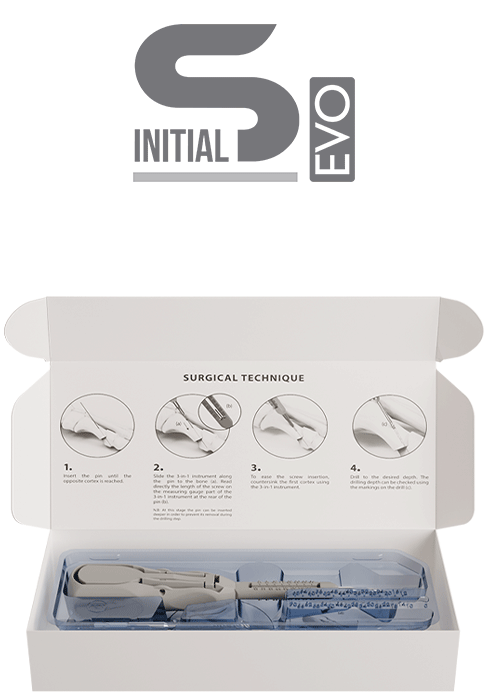
The INITIAL S EVO kits for self-compressive cannulated screws each contain a quick-connect drill bit, a 3-in-1 ancillary, a quick-connect handle, and guide wires. To simplify use and storage, the instrumentation is shared between the Ø2.6 mm and Ø3.0 mm screws, while a dedicated kit is available for Ø2.25 mm screws.
- Kit for Ø2.25 mm self-compressive cannulated screws (Ø0.9 mm cannula – length 12 to 34 mm)
- Kit for Ø2.25 mm self-compressive cannulated screws (Ø0.9 mm cannula – length 12 to 34 mm)
- Kit for Ø2.6 mm (Ø1.1 mm cannula – length 10 to 34 mm) and Ø3.0 mm (Ø1.1 mm cannula – length 10 to 40 mm) self-compressive cannulated screws
All three feature hexalobular drive recesses.
The screws are not included in the INITIAL S – Foot kit; they are available separately in individual sterile packaging (S-box).
The INITIAL S EVO instrumentation kit for Ø3.5 mm chamfered cannulated screws includes a quick-connect drill bit, a 3-in-1 ancillary (reamer, differential gauge, and screwdriver), a handle, and guide wires.
This kit has been developed for:
-
Ø3.5 mm self-compressive chamfered head cannulated screws (Ø1.5 mm cannula – length 20 to 60 mm)
These screws have been specifically designed for the treatment of Hallux Valgus in percutaneous surgery using the so-called MICA technique. They feature a 45° bevel on the threaded head. When properly indexed at the end of insertion, the bevel minimizes head protrusion, thereby reducing soft tissue irritation.
These screws can be used in combination with the G•Halva guide, an aiming guide for percutaneous forefoot surgery.
The screws are not included in the INITIAL S kit; they are available separately in individual sterile packaging (S-box).
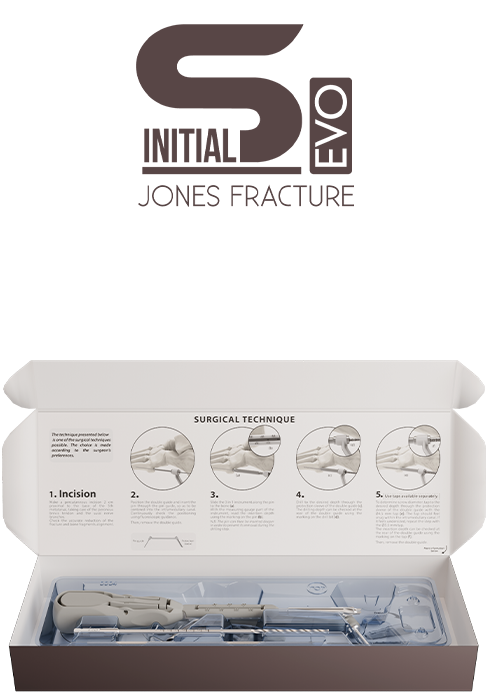
Jones fractures are one of the most common forefoot injuries. They affect thousands of active patients each year and carry a high risk of non‑union with conservative treatment, making a screw specifically engineered for this fracture essential to improve healing outcomes and reduce complications1,2.
The INITIAL S EVO – Jones Fracture kit includes a single‑use handle, a Ø2.9 mm quick‑coupling drill bit with Ø1.7 mm cannula, pins, a double guide (Ø1.7 mm pin guide and protection sleeve), and a patented 3‑in‑1 instrument integrating a differential length gauge, countersink, and screwdriver.
This kit has been developed for:
- Ø4.5 mm and Ø5.5 mm compressive screws – sterile, titanium alloy, partially threaded (lengths ranging from 35 to 65 mm)*
Sterile taps (Ø4.5 mm and Ø5.5 mm) are offered separately and are used in combination with the screws.
The screws are not included in the Initial S™ EVO Jones Fracture kit; they are available separately in sterile single‑pack.
Kavanagh A, et al., Rate of bony union after Jones fracture fixation in the general population, The Journal of Foot and Ankle Surgery, 2025; 64, 481-487
Lareau C, Anderson R, Jones Fractures Pathophysiology and Treatment, JBJS REVIEWS 2015; 3(7):e4
The INITIAL S EVO kits for Ø3.5 mm and Ø4.0 mm headed cannulated compression screws each contain a quick-coupling drill bit, a 3-in-1 instrument, a quick-coupling handle, and guide wires. Each diameter has dedicated instrumentation, with the 3-in-1 instrument combining a pin length gauge, countersink and screwdriver.
- Kit for Ø3.5 mm headed cannulated compression screws (Ø1.25 mm cannula – length 14 to 50 mm)
- Kit for Ø4.0 mm headed cannulated compression screws (Ø1.4 mm cannula – length 26 to 70 mm)
The Ø3.5 mm and Ø4.0 mm screws feature a hexalobular screw recess and are compatible with a dedicated compression washer.
The screws are not included in the INITIAL S EVO – Foot kit; they are available separately in individual sterile packaging.
Key features of the INITIAL S EVO – Foot kit.
- Evolution from hexagonal to hexalobular imprint design
- Shared instrumentation for Ø2.6mm and Ø3.0mm screws
- A patented 3-in-1 instrument for simplified use
- A sterile, single-use, ready-to-use format suitable for emergency situations:
- Reduced risk of contamination
- No waiting time for restocking
- Easier traceability thanks to detailed labeling
- Reduced operative time and costs
- Ergonomic format adapted to instrument sets